
Archived Tweets / Research Data
Codes & Themes w/wo Theoretical Memos
(derived through a process of inductive, qualitative, data analysis)
@AprilGerdom [name pseudonymized] [ontology] [04]: 1933: Die perfekte Gesellschaft ist rasserein
2015: Die perfekte Gesellschaft ist rassengemischt.
#links #Moralismus #weltoffen #Toleranz #Vielfalt #Rassen #woke #Wokuharam #Bolschewoken #Rassismus #Antirassismus #RassismusGegenWeiße #Massenmigration #Ersetzungsmigration [URL redacted]
"1933: The perfect society is racially pure
2015: The perfect society is racially mixed.
Left Moralism Cosmopolitan Tolerance Diversity Races Woke Wokuharam Bolsheviks Racism Anti-racism Racism Against Whites Mass Migration Replacement Migration"
#1933_
#PoliticsFascismNaziAryanMasterRace i.e.
#PoliticsNationalismEthno,
#PoliticsNationalismRomantic
#2015_
#PhenomnMulticulturalism,
#MetaphorPurityRaceMixingMiscegenation
#TauntLeftThe
#TauntWokeMorality
#NarrativeValuesCosmopolitan
#BehaviourTolerance
#PolicyDiversityEquityAndInclusionDEI
#ConspiracyTheory_GreatReplacement
#PoliticsCommunismBolsheviks #TheoryDeclinism


[845]
@AprilGerdom [name pseudonymized] [ontology] [04]: Linker Moralismus ist kein Hindernis für die nächste Diktatur, sondern deren Voraussetzung.
#gez #Leitmedien #Systemmedien #Lügenpresse #Kartellmedien #ard #zdf #wdr #arte #AnjaReschke #BiancaDeubel #DieLinke #linksextrem #linksversifft #woke #Moralismus #Wokuharam #Bolschewoken [URL redacted]

#NMDENorddeutscherRundfunkNDRAnjaReschke
https://www.youtube.com/watch?v=mkwcIFmukgc
https://www.wwwagner.tv/?p=29828
"Thank you so much, Mr. Perkson. Your speech was a great honour and deeply touching because it made so clear to me what has happened this year. I feel incredibly honoured. I feel honoured by your speech. I feel honoured because 80 jury members decided that I should be Journalist of the Year. It's a real compliment, because this is our industry. And yet, today, and even in the last few days when I thought about coming here and driving here, I had a really strange feeling because I thought, 'Okay, so now you're going to be Journalist of the Year in 2015, the year in which our industry, we journalists, are being questioned and attacked like I've never experienced before.' The 'lying press' is attacking us from all sides. When I think about it, 40% don't believe us anymore, we're the 'lying press.' I'm Journalist of the Year, so from their perspective, I would be the Liar of the Year. It's a terrible feeling, I have to say. In fact, that's how it is. Ms. Mils also told me that my The nomination has already generated so many comments, I read them again anyway. You're not supposed to, but I did. There are a lot of nice things, and a lot of nasty things too, but I'm used to it by now. In fact, since that comment, I've been moving around a lot. And you mustn't forget, it's a comment of one minute and 50 seconds. Yes, I mean, that's nothing. One minute and 50 seconds, Tagesthemen, August 5th. Many people were on summer vacation. The weather was even nice; you could barbecue. One minute and 50 seconds, in which I basically just said that you shouldn't just defame other people, or refugees, with hate and incitement. It actually changed so much in my life, and since then I've been in this strange cocktail of feelings. People I encounter, and who write to me--really every day now--wish me to be properly raped by this gang of black people I wanted to bring into the country. And on the other hand, there are people like what actually happened to me earlier when I got on the train at Dammtor, a man came up to me, took off his glove and came towards me. I thought to myself, 'Now you're going to get it,' but he just came up and said, 'You're V. Reschke from NDR.' I said, 'Yes, may I shake your hand?' Thank you very much, thank you very much for your reporting. My goodness, it's a strange, a strange conglomerate or a strange mixture of messiah and object of hatred. But I'm neither. That's not a role I want. I'm not the big shot again, nor am I somehow the person you have to hate now. I have nothing. I'm not an actor. I'm not a politician. I haven't decided anything. I didn't say that refugees should come. I also didn't say that they shouldn't come. I actually only reported, or in this case, commented. My role, as I said, is that of a journalist. But--and I have to admit this--I don't know what that is anymore. What's a bit frightening now is that you've chosen me as Journalist of the Year, and I'm now saying that I don't know what that means anymore. What is my task? What is our task? What are our tools? What do we have to do? This is the uncertainty I feel. And I realise that I'm not alone in this either. I notice it in my editorial office, or rather, in my editorial offices. I also notice it in many articles that have already been published. I've read many of them, and they've formulated insightful articles and thoughts on the matter. I've absorbed them all because I thought, yes, in the hope of finding salvation and somehow sensing what I have to do. I keep coming across the sentence that's often quoted now, and where everyone nods and says, 'Yes, that's exactly right.' What is that quote from Mr. Augstein? Last week I was at Der Spiegel, and I walked through that magnificent hall again. There, the sentence is displayed in large letters. I thought to myself, 'Yes, what is that?' It sounds good. That's it. That's how it has to be done. But honestly, what is it? What does it actually mean? Let's look at this topic of refugees. In the summer of 2015, a noticeably large number of people suddenly came to Germany. They came for whatever reason, with their children, without children, men, single people, and so on. There were poor souls among them who needed help. Some need to provide for them, perhaps even solving our demographic problem, while others see them as invaders threatening our country, whose potential for aggression is unknown, and who will undoubtedly bring a host of crime into the country. So what's the real story?
So, what is the right thing to do? I don't know. We reported on one side, we said, 'Yes, this could help,' but we didn't include the other side. I don't know what's going on. We had a good year at Panorama because suddenly, contextualising, evaluating, or commenting journalism experienced a great renaissance. Now, it has to be said that, of course, when you work for the ARD's political magazines and are confronted with many articles over the years, including those from their print editions, you notice that political journalism has always been somewhat downplayed. The political magazines were somewhat meaningless. Therefore, it was very nice for us that we suddenly had the feeling that we also had something to say, and we reported, and we produced great reports, and we tried to somehow contextualise what was happening for the people out there. People come along, and we tried to decode things like the AfD and Pegida, sometimes because people are afraid of them. We also tried to counter these fears by trying to present facts, to say, 'Look, not everyone is a criminal.' All the terrible rapists, so basically, I tried what you're supposed to do: counter them with facts, but it's a bit like with children. You know how it is when a child says there's a monster under the bed, and you say, 'No, look, there's no monster.' It doesn't help; the fear doesn't go away whether there's a monster or not. Facts don't help at all. So, I've found that the more we countered with facts, and the more we said, 'No, the crime statistics don't say anything about it,' and look, I don't even know how many rumours I investigated, the more we reported it, the greater the anger became, the more comments I received, the more emails I got saying things like, 'Look, someone was raped here in [location], [location], and [location], call us, men assaulted people at the swimming pool.' Then I started to investigate. I called lifeguards, I don't even know how many police stations I called in this country, asking, 'Hey, has anyone been raped here?' 'No, okay, all right.' Then I wrote back, and then I got an even longer list with... Even more rumours and even more terrible things that people had done or that refugees might have done, and I thought to myself, this is so frustrating, I'm not getting anywhere, I can't get through to them. Um, and then we still said, okay, that's right. Then Cologne happened. Cologne is a nightmare. Cologne was such a nightmare, I can't imagine it any other way, because Cologne changed so much. So, to say what's going on again, I don't know how you feel, but I still can't say what's going on. To be quite honest, I can't categorise Cologne. To this day, I don't know exactly what happened there, but it was expected of us that we would say so. Now Panorama had the problem that we broadcast on January 7th. A damn deadline, you know, after Christmas and New Year's, you have to have a show ready and prepared because you can't really film anything then. What are you going to do over the holidays? So we had a show finished. Around Monday evening, the first reports came in, and we broadcast on Thursday. On Tuesday, my editorial team and I sat down together and said, okay, well, somehow we don't have to address this, especially us at Panorama, who are now talking about it so often. We had the feeling that there wasn't actually a problem with crime, yes, we had to. We sat there like rabbits, thinking, yes, but what do we do now? We don't even know what happened. The information was so unclear. The Cologne police weren't saying anything concrete. The police chief hadn't even resigned yet. So we just sort of went on and on for hours. We have to send something out now, we have to do television. It's complicated, you can't just write something, you have to film something. So, quite honestly, we broadcast on Thursday and aired the film that had been prepared. It was a disaster. I've never felt so bad in my life. I was standing in that studio. It had happened in Cologne. I knew, or at least my impression was, because the comments online beforehand were so strong, I have to say something about it. I have to contextualise it, I have to find an assessment. But I can't find an assessment. So I said, 'I can't.' I said, 'We're sorry.' Yes, you would expect us to. We would also like to broadcast something about Cologne, but we can't give a well-founded opinion at this moment. So, we bare our souls.
Now, one could say, 'I read it in your post, Georg,' that you suggested it was a good moment, a good idea, how we can regain trust in journalism, by simply being honest about our mistakes and our inability to make judgments. Because we mustn't forget Germanwings, how we were all attacked for jumping to conclusions about why that plane crashed, and what all did I broadcast, and which experts didn't all appear on TV and in the live tickers, and I don't know what else, just quick, quick, quick, faster and faster. That was wrong, we realised that. So, Cologne, I couldn't assess it, it didn't help, it only got worse. The anger was so great, we were overwhelmed, I was inundated with such angry comments and angry emails, and even within our own station, of course, there was discussion about how this wasn't right and that we had to assess it. Yes, that's true, I would have preferred to have something about Cologne, I would have liked to have something, but honestly, I didn't have it, we didn't have it, and those are the points where I always think, okay? What is our job, then? Isn't it right that we have to evaluate something when we can't even say what it is? Even now, I think, I believe, ultimately, I've really been thinking about this since August. Yes, I think that we're ultimately building a somewhat false image of journalism, namely the idea that we can report neutrally. I also think that many people expect that; I see it again and again. Um, no, we can't do that. I think we've relied for a very long time on being an elite voice. We're the ones who can go to the minister and ask questions; we're the ones who can travel. We know what it's like; we know it; we broadcast it; we write it; bam! Can you deal with that? Unfortunately, people have noticed that even our reports are always influenced by us. There is no neutrality; not even a news minute is neutral. It's always the person who goes there who has made their selection. I don't have to tell you that; you know that ultimately everyone who makes their selection, who puts their vote on it, if we report again now, there have to be upper limits. Is that right, yes or no? Is it right that Putin is helping Assad? Is it right that... Assad is supported, we don't know if it's right or wrong, and I don't think that's our job either. We're not actors, we're not politicians, we're not the fourth estate, we're just journalists. But then what is our job? I became a journalist, and I still enjoy it because I found it so wonderful, purely for selfish reasons, that you can go anywhere, that I can talk to someone on welfare today and to the CEO of a DAX-listed company tomorrow, that I can look into all kinds of realities and share the wonderful things I experience with other people. Of course, I can try to compare it with reality, I can try to find facts and add them to the narrative, but I will always report it this way: it's always ultimately my own opinion, and I think we need to be more honest about that--my only opinion. So, if you always ask what the solution to our crisis of trust is, I don't know it, I don't know it. I can only hope that authenticity helps because, actually, and I wanted to say this in closing, it's a fantastic time for journalism. As you mentioned, I once wrote a book about the history of Panorama. Panorama was... I've been reading this 50-year-old magazine for ages, and it was only through studying the history of Panorama that I truly understood how this country, the Federal Republic of Germany, came into being and how many things we take for granted today, like freedom of the press and freedom of expression, had to be fought for, how many taboos had to be broken, and who did it? It was critical journalists, yes, critical journalists who repeatedly brought these issues to the forefront and got beaten up for it, and so on. And we all know that when we look back at our historical newspapers and broadcasts, every ten years or so there are anniversaries, and then we dig up all the big old scandals. And I caught myself thinking, 'Wow, the '60s, that was a wild time.' I was a little envious of the KLE (presumably referring to the magazine or similar) because the republic was shaking back then. Things were really happening back then. And I thought to myself, 'Nothing's shaking around here anymore.' Because whether I'm just going to tell the story of how Grandma X was deducted from her health insurance or...
He said that the pension contribution won't be increased after all, and now the republic isn't just wobbling anymore, but it's wobbling again, wobbling again. I feel it extremely strongly, and I notice that when the republic wobbles, the kick doesn't exactly get stronger; you feel it in your gut. And I believe, um, with this feeling, we don't have to cave in now, we don't have to say, 'Well, then we can't do it anymore,' or 'We give up.' But I believe it's precisely the moment now where journalism is reorganising itself, where we are once again there for this country and this society, because it's about redefining fundamental social questions. But I believe we can no longer continue with the old elitist role and claim we know what's what. That means my employer, and my, um, my thought is, if I take this prize home now, so that I don't get too weighed down and then have talked everyone down, but rather, one has to look positively ahead. That's what I want to do, too. So, my thought is, if I take this prize home now, I'll hang it on the wall and tell myself, 'Everything's clear.' You're now saying what is, specifically how you feel about it, and you're explaining why you feel that way, and I think we're trying to find out what is and, um, to continue to critically observe this society, but not to act as if we know everything better. Thank you very much for this prize."
#2015_
#ToponymEuropeGermanyCologne


[42]
@MarleneMatelski [name pseudonymized] [ontology] : I only tweet this to show how @DrProudman is all over the map & in need of therapy & has no credibility - het cult wants classics rewritten for #woke #Feminism yet here praising #Patriarchy saving a woman
CANNOT. MAKE. IT. UP.
#DrProudman make it make sense
#FeminismIsCancer [URL redacted]

#2005_PrideAndPrejudice
https://www.youtube.com/watch?v=qwVRoUxr9pk&t=55s
#IRLHistoricalFigureJaneAusten "I'm 27 years old, I've no money and no prospects. I'm already a burden to my parents and I'm frightened".
#IRLLawyerBarristerCharlotteProudman [Wikipedia]
Addendum For some, Proudman is seemingly a contentious figure - see the following from #2015_ #NewspaperUKBrdshtTheGuardianCarolineDavies "When junior barrister Charlotte Proudman tweeted a screenshot of her LinkedIn exchange with a senior City solicitor, rebuking him for complimenting her on her profile photograph, the backlash was phenomenal. Proudman, 27, had not expected the furore. 'Never, not in a million years', she says. But her actions detonated an explosive and deeply divisive sexism debate and she found herself engulfed. Three months later, she has no regrets, despite finding herself condemned as a 'feminazi' and subjected, she says, to death and rape threats on social media. She said the fallout won't stop her working at the Bar, though she has yet to see if it will affect her career as a barrister. 'Yes, I have had to pay a personal price', she agrees, but she believes it is a price worth paying to highlight the issue of gender equality at work." https://www.theguardian.com/society/2015/dec/29/charlotte-proudman-feminazi-barrister-linkedin-sexism-row #BrandTechSocialMediaLinkedIn
Addendum For some, Proudman is seemingly a contentious figure - see the following from #2015_ #NewspaperUKBrdshtTheGuardianCarolineDavies "When junior barrister Charlotte Proudman tweeted a screenshot of her LinkedIn exchange with a senior City solicitor, rebuking him for complimenting her on her profile photograph, the backlash was phenomenal. Proudman, 27, had not expected the furore. 'Never, not in a million years', she says. But her actions detonated an explosive and deeply divisive sexism debate and she found herself engulfed. Three months later, she has no regrets, despite finding herself condemned as a 'feminazi' and subjected, she says, to death and rape threats on social media. She said the fallout won't stop her working at the Bar, though she has yet to see if it will affect her career as a barrister. 'Yes, I have had to pay a personal price', she agrees, but she believes it is a price worth paying to highlight the issue of gender equality at work." https://www.theguardian.com/society/2015/dec/29/charlotte-proudman-feminazi-barrister-linkedin-sexism-row #BrandTechSocialMediaLinkedIn

#NewspaperUSBrdshtNewYorkTimesAlexandraAlter and
#NewspaperUSBrdshtNewYorkTimesElizabethHarris
https://www.nytimes.com/2023/04/03/books/classic-novels-revisions-agatha-christie-roald-dahl.html (3 April / 5 April 2023).
#IRLAuthorNovelistAgathaChristie
#IRLAuthorNovelistRoaldDahl
#IRLAuthorNovelistIanFleming
#IRLAuthorNovelistUrsulaLeGuin [Wikipedia]
[338]
@SadieSarenana [name pseudonymized] [ontology] [26]: #MAGA #TRUMP2024 #WokeMindVirus #woke #Ukraine #CORRUPTION #J6CoverUp #TreasonHasConsequences #loveisland #BudLightSeltzer #CryptoGPT #ElectionResults #FortniteMEGA #InternationalWomensDay #statehouse #Welcome7DREAMtoThailand #XiaoZhan #TRUMP2024ToSaveAmerica #ArrestFauci… [URL redacted] [URL redacted]

[241]
@PattyUdy [name pseudonymized] [ontology] [03]: #Nazi-"Helden" des #ÖRR, der BRD-#Ampel, der #NAFO-Westimperialisten, #Neocons, #Woke-#Hipster und #Kriegstreiber-Front.
#BMGFCB #wwds #DSDS #MSC2023 #VFBKOE #Benachrichtigungen #Gladbach #Streumunition #Karneval #Phosphor #Warteschlange #Schiri #Elton #Authy #Rassismusproblem [URL redacted]

#NewspaperUKTabloidTheDailyMailWillStewart, #NewspaperUKTabloidTheDailyMailFloraDrury
#IRLHistoricalFigureJoanOfArc
#MagazineElle
#OrgUAAFUAidarBattalion
#OrgUAAFUVictoriaZaverukhaAKAVitaZaverukha [Wikipedia]
#PoliticsFascismNaziNeoFarRightAltRightRadicalRight
#2015_
Context https://www.amnesty.org/en/documents/eur50/040/2014/en/
Context https://www.amnesty.org/en/documents/eur50/040/2014/en/
[573]
@NoraBoult [name pseudonymized] [ontology] [02]: We need to stop govt and media from corrupting, sexualising and grooming our children into this degraded lifestyle choice. This Weimar filth must be swept off our streets. #LGBTplusHM #LiberalismIsAMentalDisease #woke [URL redacted]
#TheoryAffectExpressionIndignation
#MetaphorThreatExistential
#TheoryPsychologySelfDeterminationTheorySDT
#PhenomnCorruption
#IdentityLGBTQIACodingHypersexualizationGrooming
#IdentityLGBTQIAGay
#IdentityLGBTQIALifestyle
#ToponymEuropeGermanyThuringiaWeimar [Wikipedia]
#MetaphorDiseaseMental
#MetaphorWarfareHeroGuardianOfChildhoodInnocence

#OtheringOutGroupTransgressiveDeviant
#TheoryHypercultureHybridity
#IRLAuthorTrystanReese [Wikipedia]
#NewspaperUKBrdshtMetroJoeGamp "Transgender man reveals he is eight months pregnant with gay boyfriend after he stopped taking testosterone" https://metro.co.uk/2017/06/07/transgender-man-reveals-he-is-eight-months-pregnant-with-gay-boyfriend-after-he-stopped-taking-testosterone-6691400/
#IdentityLGBTQIATransmasculine
#IdentityLGBTQIATrans
#PhenomnSexualityFetishLeather [jpg]
#NewspaperUKBrdshtTheIndependentNatashaCulzac https://www.independent.co.uk/arts-entertainment/music/glastonbury-2014-the-truth-behind-the-viral-naked-hippie-picture-9571190.html
#2014_
#OrgUKGlastonburyFestival
#EventLGBTQPrideMonth_
#PhenomnSexualityAdultSexToysDildo
#IRLEntertainerDesmondNapolesAKADesmondIsAmazing [Wikipedia]
#NewspaperUSBrdshtNewYorkTimesAliceHines "From an early age Desmond was theatrical, said Wendy Napoles, his mother. There were dresses fashioned out of household items like recycled cardboard, ribbons, towels, Bubble Wrap. Once, she said, at a mall food court, Katy Perry's 'Firework' came on and he broke into an impromptu dance routine.
Desmond pegs his start in the world of drag to 2015, when videos of him vogueing at the New York Pride parade went viral; at one point, a high kick sent a flip-flop soaring over the crowd. Next came gigs channeling Gwen Stefani and David Bowie, along with runway shows for Gypsy Sport and the Blonds.
'Other moms are a soccer moms,' Ms. Napoles said. 'They take their kids to practice, to games, they cheer for their kids. That's how I see myself with drag.'" https://www.nytimes.com/2019/09/07/style/self-care/drag-kids-desmond-the-amazing.html
#2015_
#IdentityDragQueen
#IdentityLGBTQIATransgenderYouth
#PhenomnSexualityHypersexualization
#IRLEntertainerJorgeAlcantarAKAXochiMochi [fact-checked]
#IdentityDragQueen
#2001_ItsOkayToBeDifferent
#PhenomnDragQueenStoryHourDQSH [Wikipedia]
#2017_
[1503]
@DesireeRozelle [name pseudonymized] [ontology] [05]: #britainfirst #loyal, #honourable ex #britisharmy #veteran #crusaderman #Liverpool, [URL redacted] & #Sthelens in #Merseyside.vs #woke #victoria #teaching #uk #woke #haters #bigots #britainfirst #loyal, #honourable ex #britisharmy #veteran #crusaderman.
https://www.youtube.com/watch?v=lYWnedIhTss
#OrgClassifPPUKBritainFirst
#OrgClassifPPUKBritainFirstPaulGolding [Wikipedia]
#2015_
Context https://www.bbc.co.uk/news/uk-northern-ireland-48440464 #NMUKBBCOneSpotlight https://www.youtube.com/watch?v=sdv6Xy2LDIQ #ToponymEuropeUKNorthernIrelandBelfast #OrgUKGBNIRLocalGovernmentDistrictsLGDJoleneBunting [LinkedIn] #OrgClassifPPUKBritainFirstJaydaFransen [Wikipedia] #SymbolEmblemFlagUKUnionJack #PoliticsNationalismBritish [Wikipedia] #AdvocacyUKHopeNotHateMatthewCollins #OrgSyndicateTerrorismParamilitaryUlsterLoyalism
Context https://www.bbc.co.uk/news/uk-northern-ireland-48440464 #NMUKBBCOneSpotlight https://www.youtube.com/watch?v=sdv6Xy2LDIQ #ToponymEuropeUKNorthernIrelandBelfast #OrgUKGBNIRLocalGovernmentDistrictsLGDJoleneBunting [LinkedIn] #OrgClassifPPUKBritainFirstJaydaFransen [Wikipedia] #SymbolEmblemFlagUKUnionJack #PoliticsNationalismBritish [Wikipedia] #AdvocacyUKHopeNotHateMatthewCollins #OrgSyndicateTerrorismParamilitaryUlsterLoyalism
[147]


#BeliefTheismChristianity
#ToponymEastMiddleSyria
#MetaphorWarfareHeroProtector
Context #MagazineNewSerbianPoliticalThoughtNSPM [Wikipedia] "Orthodox Christians in Syria celebrated Christmas About 2 million Syrian Christians (mostly Orthodox) celebrated Christmas safely in Damascus and other cities under the control of the Syrian army, despite the proximity of the front with the Islamists. A large number of people celebrated on the streets of Damascus, and were joined by Muslim friends. 'We feel safe here. Thanks to the army and the police, my family can walk the streets of Damascus in peace,' said one of the city's residents. 'Things are changing, and I feel like next year will be better for everyone.' 'We celebrate our unity, our army, our country,' said some of the Christian women celebrating Christmas in Damascus. Festivities, demonstrations, and concerts were held throughout Damascus, so nothing seemed like a war against Islamists was taking place nearby. In the Orthodox city of Sadad, which is right in the line of fire with the Islamists, the situation is much more difficult, and citizens are in greater fear. 'The presence of Hezbollah in the city is the biggest Christmas gift for us, regardless of religion,' said Mayor Sadada Khalil (26 December 2015)." #ToponymEastMiddleSyriaDamascus #BeliefTheismChristianityDenomEasternOrthodoxy #2015_
Context #MagazineNewSerbianPoliticalThoughtNSPM [Wikipedia] "Orthodox Christians in Syria celebrated Christmas About 2 million Syrian Christians (mostly Orthodox) celebrated Christmas safely in Damascus and other cities under the control of the Syrian army, despite the proximity of the front with the Islamists. A large number of people celebrated on the streets of Damascus, and were joined by Muslim friends. 'We feel safe here. Thanks to the army and the police, my family can walk the streets of Damascus in peace,' said one of the city's residents. 'Things are changing, and I feel like next year will be better for everyone.' 'We celebrate our unity, our army, our country,' said some of the Christian women celebrating Christmas in Damascus. Festivities, demonstrations, and concerts were held throughout Damascus, so nothing seemed like a war against Islamists was taking place nearby. In the Orthodox city of Sadad, which is right in the line of fire with the Islamists, the situation is much more difficult, and citizens are in greater fear. 'The presence of Hezbollah in the city is the biggest Christmas gift for us, regardless of religion,' said Mayor Sadada Khalil (26 December 2015)." #ToponymEastMiddleSyriaDamascus #BeliefTheismChristianityDenomEasternOrthodoxy #2015_

#BeliefTheismJudaismStarOfDavid
#OrgUSFedCIA ?
Addendum the use of the #MetaphorDeceitUnmasking, the positioning of the figure/model and compositional arrangement of the final work strongly resemble that of #IRLPainterDeanMartinAKATheMadArtist's painting series [tweet] (where the initials of the #OrgSyndicateTerrorismParamilitaryIRA, which have been painted onto the #SymbolHeadgearBalaclava of #OrgClassifPPUKLabourJeremyCorbyn are instead replaced with #OrgSyndicateTerrorismISISDaeshISIL, inscribed onto a balaclava being worn by #OrgClassifPPILLikudBenjaminNetanyahu).
Addendum the use of the #MetaphorDeceitUnmasking, the positioning of the figure/model and compositional arrangement of the final work strongly resemble that of #IRLPainterDeanMartinAKATheMadArtist's painting series [tweet] (where the initials of the #OrgSyndicateTerrorismParamilitaryIRA, which have been painted onto the #SymbolHeadgearBalaclava of #OrgClassifPPUKLabourJeremyCorbyn are instead replaced with #OrgSyndicateTerrorismISISDaeshISIL, inscribed onto a balaclava being worn by #OrgClassifPPILLikudBenjaminNetanyahu).

[662]

"EVERYONE NEEDS TO BUY AN ELECTRIC VEHICLE
I'LL BE ABLE TO CHARGE IT, RIGHT?
...RIGHT?"
#OrgClassifPPUSDemocraticPartyGavinNewsom [Wikipedia] i.e. Democratic Party Governor of
#ToponymAmericaNorthUSCalifornia
#FictionalCharacterStarWarsPadmeAmidala [Wikipedia]
#LiteralVehicleCarPluginHybridElectricVehiclePHEV
Addendum Newsom's characterisation here is that of 'California progressivism', which is seemingly, out-of-touch with 'everyday people'; he (and his ilk) are weak while 'everyday people' are strong. #OtheringElitesOutOfTouchLatteSipping #CharacterisationWeaknessEffete #ReasoningFallacyAppealToTraditionEverydayPeopleEveryman #MetaphorVersusEverydayPeopleLiberals
The above meme appears to be a repurposed version of #FictionalCharacterStarWarsAnakinSkywalker talking to Padmé Amidala e.g. https://imgflip.com/memegenerator/322841258/Anakin-Padme-4-Panel
Addendum Newsom's characterisation here is that of 'California progressivism', which is seemingly, out-of-touch with 'everyday people'; he (and his ilk) are weak while 'everyday people' are strong. #OtheringElitesOutOfTouchLatteSipping #CharacterisationWeaknessEffete #ReasoningFallacyAppealToTraditionEverydayPeopleEveryman #MetaphorVersusEverydayPeopleLiberals
The above meme appears to be a repurposed version of #FictionalCharacterStarWarsAnakinSkywalker talking to Padmé Amidala e.g. https://imgflip.com/memegenerator/322841258/Anakin-Padme-4-Panel

"NOW HERE'S A TARGET WE CAN SUPPORT
ZERO GREENS BY 2025"
#SymbolEmblemFlagAustralia (with
#SymbolEmblemFlagUKUnionJack upper hoist quarter of the flag overtly visible).
#OrgClassifPPAUSAustralianGreensSarahHansonYoung
#OrgClassifPPAUSAustralianGreensAdamBandt
#OrgClassifPPAUSAustralianGreensLidiaThorpe [Instagram] [forum] The post is from 18 August 2020 - three months after George Floyd's murder on 25 May 2020. And so, presumably, the alteration/wearing of the
#SymbolEmblemFlagAustralianAboriginal [Government] is about showing solidarity with
#CauseBlackLivesMatterBLM
#SloganZeroGreensBy2025
#HandleFacebookAussieStuffForAussiesASfAChrisoAken [tweet] [forum] [forum] [Instagram] [channel] [channel] [blog]
Context the meme includes a logo, which points to the 'Aussie Stuff for Aussies' Facebook Page. The page purports to be "Aussie satire with a splash of profanity" but, which includes multiple examples of #PoliticsNationalismWhite + #ConspiracyTheory_GreatReplacement, [forum] [forum] recycling memes such as #MemeHowToRuinACity as well as ads for #PoliticsNationalismAustralia (such as this image, which imagines Hanson as an Australian #IRLHistoricalFigureJoanOfArc - perhaps, acting under some sort of 'divine guidance' #PhenomnAgencyDivineRight - while casting her voters - through inference - as 'defenders' of the country's 'sanctity' #MetaphorWarfareHeroResistance) [forum] + #OrgClassifPPAUSOneNationPartyPaulineHanson and #PoliticsNationalismBritish supposed #MetaphorDogWhistleTakeBack marches [forum] [forum] [forum] including one of #IRLIdeologueStephenYaxleyLennonAKATommyRobinson's promoting his 'March For England' #MetaphorDeceitDisingenuousGrift scheduled for 13 September 2025 [forum] The clip is captioned with the: "WILL YOU BE SILENT OR WILL YOU ROAR 13th SEPTEMBER" call-to-action. And is seemingly, being organised by #OrgSyndicateHateGroupUKMarchForEnglandMFEDaveSmeeton [RationalWiki] [networks of influence] #AdvocacyUKHopeNotHateMatthewCollins "March For England, a kind of 'EDL lite' for aging football hooligans predates the EDL by several years, emerging from the now defunct United British Alliance. They are a separate entity to the younger EDL, however have co-operated closely when it has come to marches and demonstrations, taking part in each others events with activists overlapping both of the organisations." [HOPE not hate] #PoliticsNationalismBritishEnglish #OrgSyndicateHateGroupUKEnglishDefenceLeagueEDL #OrgSyndicateHateGroupUKUnitedBritishAllianceUBA [pdf] #OrgSyndicateHateGroupUKCasualsUnited [Wikipedia]
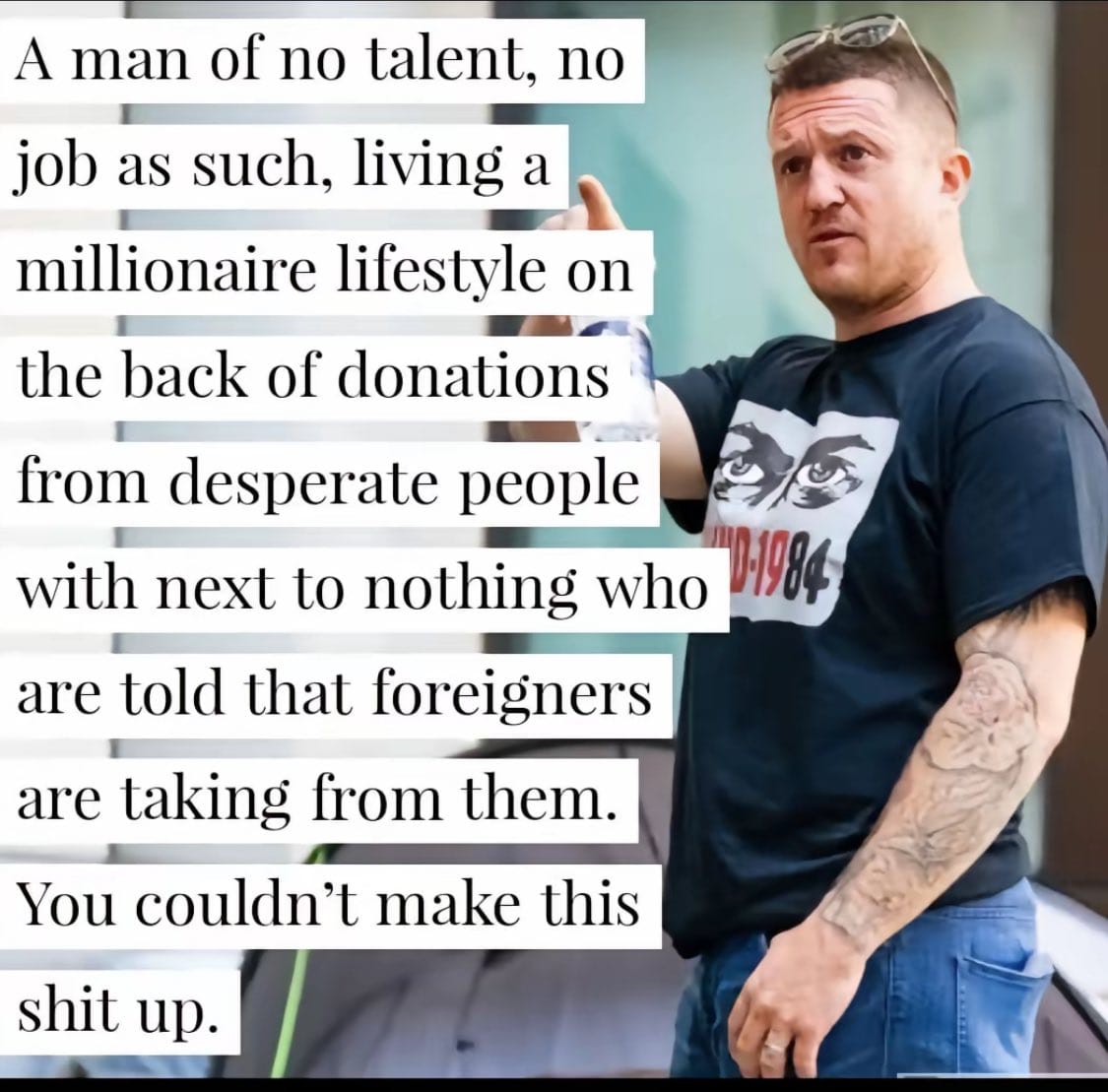
#NewspaperUKOnlineDorsetEye "[Stephen Yaxley-Lennon AKA Tommy Robinson] has a long history of misleading supporters, portraying himself as a persecuted patriot while using public donations to fund his personal life and legal problems. His so-called fight for 'freedom' is a lucrative business model built on fear and outrage. Supporters deserve honesty. When someone claims to be standing for truth but hides the truth about their own affairs, that is not leadership. It is deceit. The bankruptcy filings and public records make it clear that the problem was not persecution but mismanagement and dishonesty." https://dorseteye.com/ever-wondered-what-stephen-yaxley-lennon-spends-his-donations-on/ [jpg]
#NMAUSBSNewsElfyScott "Australia has also seen a number of anti-immigration marches in recent weeks. On Saturday, protesters marched in capital cities calling for an end to 'mass migration'. The lead organisers of that event posted a notice on their website distancing themselves from any connection with Tommy Robinson or his views. Two weeks earlier, there were the nationwide 'March for Australia' rallies, which were attended by members of the neo-Nazi National Socialist Network and allowed neo-Nazi leader Thomas Sewell to address crowds in Melbourne. The March for Australia rallies also received notable support from far-right figures, including Tommy Robinson and Elon Musk. ... Callum Jones, a political extremism researcher from Monash University, told SBS News grievances such as economic and social uncertainty play a role in political mobilisation for the far right and these groups capitalise on issues such as housing and the high cost of living to gain momentum. 'In the same way, we saw large-scale political mobilisation around the COVID-19 period where you had a lot of people turn out [to protests] because of perceived infringements on civil liberties and they were turning to protest things like mask mandates and vaccine mandates,' he said. Jones said far-right politics focus on grievances and perceptions around 'entitlements or privileges or access to resources that are being taken away' and 'certain groups are scapegoated as being the people who have taken away those previously accessible resources or privileges'." https://www.sbs.com.au/news/article/far-right-movements-australia-uk/qg4lpzb6n https://www.youtube.com/watch?v=byb0Xl0SpIA #CatchcryAussieAussieAussieOiOiOi [Wikipedia] https://www.youtube.com/watch?v=DikLFodkmY8 #EDUAUMonashUniversityCallumJones #EDUAUDeakinUniversityGregBarton #2025_MarchForAustralia #OrgSyndicateHateGroupAUNationalSocialistNetworkNSNThomasSewell [Wikipedia] [Wikipedia] #ToponymOceaniaAustraliaVICMelbourne #TheoryGrievancePolitics #PhenomnUncertainty #ConditionVirusCOVID19Pandemic #CauseCivilLiberties #PhenomnMaskWearing #LiteralVaccineMandate #PhenomnMisdirectionScapegoating https://www.sbs.com.au/news/podcast/party-time
#NewspaperAUBrdshtTheAgeSherrynGroch and #NewspaperAUBrdshtTheAgeRachaelDexter "Footage analysed by this masthead as well as research group The White Rose Society shows neo-Nazi leadership played a key role at every major march held in capital cities on August 31, including Sydney, Hobart, Perth and Brisbane. The man who handed federal MP Bob Katter a rune-covered megaphone during the Townsville march can be revealed as the head of the NSN's north Queensland chapter, for example. Meanwhile, a March for Australia planning chat for Melbourne leaked to this masthead is stacked with known NSN members. Some have bragged of turning a crowd with just a handful of men. Others are calling for more violence - lionising the scenes that played out at the end of the Melbourne rally when Sewell and some of his followers allegedly stormed a nearby Indigenous camp and assaulted counter-protesters." [digital archives] #ToponymOceaniaAustraliaNSWSydney, #ToponymOceaniaAustraliaTasmaniaHobart, #ToponymOceaniaAustraliaWAPerth and #ToponymOceaniaAustraliaQLDBrisbane #IdentityFirstNationsAboriginalAndTorresStraitIslanderPeoples #IRLPersonalityInfluencerHugoLennonAKAAuspill #OrgSyndicateHateGroupUKCombat18AKAC18AKA318 [Wikipedia] #AdvocacyUSTheWhiteRoseSociety https://thewhiterosesociety.com/about/ #TVAUABCNews https://www.youtube.com/watch?v=JYF3xnxxotQ
#NMUKITVChannel4News https://www.youtube.com/watch?v=Y-AtqNKmVj8 #PoliticsFascismNaziNeoFarRightAltRightRadicalRight #BeliefTheismChristianityTheLordsPrayer [Wikipedia] #PhenomnRevolutionCultural #NarrativeValuesBritish #NarrativeValuesNormativeStatementTraditionalValues #2025_MarchForEnglandAKAUniteTheKingdom (including this meme, which uses the infantile 'rent boy' i.e. #IdentityLGBTQIA attack against #OrgClassifPPUKLabourKeirStarmer [forum]. #OrgClassifPPUKConservativePartyTonyGillias #AdvocacyUKStandUpToRacism https://standuptoracism.org.uk/whitehall-far-right-riot-is-a-wake-up-call-for-us-all/ #PhenomnPolarisationPoliticalTheBigSort #PhenomnImmigration #NMUKSkyNewsTomCheshire [Muckrack] https://www.youtube.com/watch?v=oV92B4oR6FM #PoliticsNationalismChristian #IRLIdeologueKatieHopkins #IRLActorLaurenceFox #IRLEntrepreneurElonMusk #CatchcryFreeSpeechFreedomOfSpeech This post is followed by an image stating: "Vale Charlie" #AdvocacyTurningPointTPUSACharlieKirk
#NMEUEuronewsGavinBlackburn [Muckrack] "But those remarks did not seem to cut much ice with Musk, who branded Farage 'weak' and threw his support behind the new Advance UK party, an offshoot of Reform founded by former deputy leader Ben Habib and backed by far-right activist Tommy Robinson. 'Advance UK will actually drive change,' Musk claimed in his X post. Musk was replying to a post by Robinson in which he urged former Reform MP Rupert Lowe to join Advance after an earlier split with Farage. 'Unfortunately, the reality is that Farage will do almost nothing to protect Britain. That is obvious,' Musk said of Farage in an earlier post. Habib founded Advance UK in June of this year, following disagreements with Farage that led to his departure from Reform UK in December. Situated at the same end of the political spectrum as right-wing Reform, Advance advocates for the UK's 'Christian constitution,' freedom of speech and adherence to UK law. Attention from Musk has boosted the influence of members of far-right fringe parties in the UK." https://www.euronews.com/2025/08/27/musk-brands-reform-uk-leader-farage-weak-sauce-after-illegal-immigration-crackdown-pledge #OrgClassifPPUKReformUKPartyLtdFKATheBrexitPartyLtdNigelFarage #LegislationEUEuropeanConventionOnHumanECHR #BrandTechSocialMediaXFKATwitter #OrgClassifPPUKRestoreBritainLtdRupertLowe [Wikipedia] [Wikipedia] #PoliticsNationalismChristian #OrgClassifPPUKAdvanceUKPartyLtdBenyaminHabib [Wikipedia] #OrgClassifPPUKIntegrityParty #OrgClassifPPUKReformUKPartyLtdFKATheBrexitPartyLtdZiaYusuf [Wikipedia]
Supplementary #MagazineNewStatesmanJuliaRampen [Muckrack] "By the time Robinson was released from prison in November 2014, a refugee crisis was engulfing Europe. Instead of returning to the streets of Britain, he travelled to Germany and sought to expand the country's anti-Islam movement, Pegida (Patriotic Europeans Against the Islamisation of the West). Next came Brexit, Donald Trump and a new term for a slippery, extremist ideology now dominating corners of the internet: the alt-right. Robinson spied an opportunity. He became a columnist for Canadian far-right website Rebel Media and cultivated a YouTube channel. Until being banned by Twitter earlier this year, he had 413,000 followers. ... But this was not the story the world heard. 'Reason *1776 for the original *Brexit. Don't let America follow in those footsteps,' tweeted Donald Trump Jr, the US president's eldest son, about the case. Conservative US radio host Rush Limbaugh acknowledged that Robinson had 'technically violated a judge's order', but told listeners that 'the real thing to take away from this story is that they categorise this guy as 'far right', which then permits them to spirit him away'. Australian supporters held rallies. In the UK, petitions to 'free Tommy Robinson' have attracted hundreds of thousands of signatures. 'I'm sick of being the silenced majority in my own country and I need people like Tommy to fight my corner,' one supporter wrote. On 9 June 2018, as many as 15,000 protesters gathered in central London under the *FreeTommy banner. To his supporters, Robinson is the victim of an oppressive state. Those watching the latest march felt differently; one described the mood to me as 'creepy and uncomfortable'. There is no doubt that, for many, it is Robinson the street fighter who most appeals. 'It is a class culture war,' Jonathan Rutherford, an academic and one of the leading Blue Labour thinkers, told me. Robinson the man, it seems, is less important than what he represents. 'Robinson is a tribune of that working-class white identity - although he'd probably not like the white identity bit,' said Rutherford. 'He's for them, and of them, and who else is?'" https://www.newstatesman.com/politics/2018/06/how-tommy-robinson-became-folk-hero-global-alt-right #2014_ #2015_EuropeanMigrantCrisis #OtheringHateIslamophobiaAntiMuslim #OrgSyndicateHateGroupDEPatriotischeEuropaerGegenDieIslamisierungDesAbendlandesPEGIDA [Wikipedia] https://www.dw.com/en/german-issues-in-a-nutshell-pegida/a-39124630 #PhenomnBrexit #IRLBusinesspersonDonaldTrumpJr #IRLShockJockRushLimbaugh #ToponymOceaniaAustralia #CatchcrySilentMajority #MetaphorWarfareHeroFolk #MetaphorMartyrFreeSpeech #CampaignHashtagFreeTommy #NewspaperUKBrdshtTheGuardianMarkTownsend https://www.theguardian.com/uk-news/2018/jul/29/tommy-robinson-far-right-resurgence-steve-bannon-us-support #IdentityClass #TheoryAffectSecondClassCitizen #IRLScholarJonathanRutherford [Wikipedia] #AdvocacyUKBlueLabour [Wikipedia] #IdentityClassBlueCollarWhite
#OrgUKTheOxfordUnionSociety https://www.youtube.com/watch?v=_YQ94jFg_4A&t=56s #2015_ #AdvocacyUKUniteAgainstFascismUAF [Wikipedia] #AdvocacyUKNationalAssemblyAgainstRacismNAAR [Wikipedia] #ToponymEuropeUKEnglandBedfordshireLuton #OrgSyndicateTerrorismSAAlMuhajirounTheMagnificent19 [Wikipedia] #BeliefTheismIslamismMosque #TheoryPsychologyPsychosocialSocialChangeCoping [academic source]
#NMUKSkyNewsKaterinaVittozzi https://www.youtube.com/watch?v=TO3d_oSIezQ&t=5s https://news.sky.com/story/flatplan-13433370 #ToponymEuropeUKEnglandYorkshireWestWakefield [Wikipedia] #PhenomnImmigrationRefugeeAsylumSeeker #ToponymEuropeUKEnglandYorkshireWestLeeds #PhenomnImmigrationRefugeeAsylumAccommodation #SloganProtectOurKids #MetaphorWarfareHeroGuardianOfChildhoodInnocence #AdvocacyUKStandUpToRacism [Wikipedia]
#VlogLotusEatersCarlBenjaminAKASargonOfAkkad https://www.youtube.com/watch?v=Eh6u8zmbtOo #IRLYouTuberGaryStevenson [Wikipedia] #PhenomnMulticulturalism #TauntLeftRadical #NarrativeUtopiaHomeland #MetaphorWarfareUnderAttack #PhenomnDemographyPieChart #TheoryDeclinismWhatHappened #ReasoningFallacyZeroSumThinking #TheoryAffectSecondClassCitizen #OrgClassifPPUKReformUKPartyLtdFKATheBrexitPartyLtdVoter
#WebsiteTheConversationEdHarrison, #WebsiteTheConversationOliviaBrown "Last September, Reform leader Nigel Farage dismissed a policy of mass deportations as a 'political impossibility'. Now, a year on, the party has pledged to deport up to 600,000 illegal migrants and retrospectively strip indefinite leave to remain from people already settled in the UK. This is a drastic lurch to the right, even for Reform. Only last year the party was saying it seeks to represent the 'silent majority' and keep out 'extremists'. In explaining this shift, Reform politicians would probably claim this is what the silent majority wants. They would point to a hardening of public opinion on illegal migration." https://theconversation.com/inside-the-far-right-social-media-ecosystem-normalising-extremist-ideas-in-uk-politics-266948 #CharacterisationBoriswave #IRLDogmatistConnorTomlinson [Wikipedia] #NewspaperUKBrdshtTheTelegraphStevenEdginton #OrgClassifPPUKReformUKPartyLtdFKATheBrexitPartyLtd #MagazineUKTheSpectatorGusCarter "One of the striking aspects of the AfD's success in the German elections was the party's popularity among the young, especially men under 25: one in four voted for the hard-right movement. Support for bracingly conservative positions among Gen-Z men isn't just a German phenomenon, however. In Westminster and beyond, a new breed of young right-wing influencers is seeking to shift our politics. Meet the Zoomer Doomers." https://www.spectator.co.uk/article/meet-the-zoomer-doomers-britains-secret-right-wing-movement/ #OrgClassifPPDEAfDAlternativeFurDeutschland #MetaphorGenerationGenZ #PowerControlMicrofascismBullyingCyberTrolling #CharacterisationZoomerDoomer #PhenomnTacticFromPostingToPolicy
#BrandPoliticsJOE https://www.youtube.com/watch?v=FhoIDeTTVdU #2026_UniteTheKingdom
Addendum although, none of the above mentions the #SymbolEmblemFlagAustraliaEureka [Wikipedia] I am reminded of this symbol and its historical use within similar contexts in Australia. #ToponymOceaniaAustraliaVICBallarat [Wikipedia]
Context the meme includes a logo, which points to the 'Aussie Stuff for Aussies' Facebook Page. The page purports to be "Aussie satire with a splash of profanity" but, which includes multiple examples of #PoliticsNationalismWhite + #ConspiracyTheory_GreatReplacement, [forum] [forum] recycling memes such as #MemeHowToRuinACity as well as ads for #PoliticsNationalismAustralia (such as this image, which imagines Hanson as an Australian #IRLHistoricalFigureJoanOfArc - perhaps, acting under some sort of 'divine guidance' #PhenomnAgencyDivineRight - while casting her voters - through inference - as 'defenders' of the country's 'sanctity' #MetaphorWarfareHeroResistance) [forum] + #OrgClassifPPAUSOneNationPartyPaulineHanson and #PoliticsNationalismBritish supposed #MetaphorDogWhistleTakeBack marches [forum] [forum] [forum] including one of #IRLIdeologueStephenYaxleyLennonAKATommyRobinson's promoting his 'March For England' #MetaphorDeceitDisingenuousGrift scheduled for 13 September 2025 [forum] The clip is captioned with the: "WILL YOU BE SILENT OR WILL YOU ROAR 13th SEPTEMBER" call-to-action. And is seemingly, being organised by #OrgSyndicateHateGroupUKMarchForEnglandMFEDaveSmeeton [RationalWiki] [networks of influence] #AdvocacyUKHopeNotHateMatthewCollins "March For England, a kind of 'EDL lite' for aging football hooligans predates the EDL by several years, emerging from the now defunct United British Alliance. They are a separate entity to the younger EDL, however have co-operated closely when it has come to marches and demonstrations, taking part in each others events with activists overlapping both of the organisations." [HOPE not hate] #PoliticsNationalismBritishEnglish #OrgSyndicateHateGroupUKEnglishDefenceLeagueEDL #OrgSyndicateHateGroupUKUnitedBritishAllianceUBA [pdf] #OrgSyndicateHateGroupUKCasualsUnited [Wikipedia]
#NewspaperUKOnlineDorsetEye "[Stephen Yaxley-Lennon AKA Tommy Robinson] has a long history of misleading supporters, portraying himself as a persecuted patriot while using public donations to fund his personal life and legal problems. His so-called fight for 'freedom' is a lucrative business model built on fear and outrage. Supporters deserve honesty. When someone claims to be standing for truth but hides the truth about their own affairs, that is not leadership. It is deceit. The bankruptcy filings and public records make it clear that the problem was not persecution but mismanagement and dishonesty." https://dorseteye.com/ever-wondered-what-stephen-yaxley-lennon-spends-his-donations-on/ [jpg]
#NMAUSBSNewsElfyScott "Australia has also seen a number of anti-immigration marches in recent weeks. On Saturday, protesters marched in capital cities calling for an end to 'mass migration'. The lead organisers of that event posted a notice on their website distancing themselves from any connection with Tommy Robinson or his views. Two weeks earlier, there were the nationwide 'March for Australia' rallies, which were attended by members of the neo-Nazi National Socialist Network and allowed neo-Nazi leader Thomas Sewell to address crowds in Melbourne. The March for Australia rallies also received notable support from far-right figures, including Tommy Robinson and Elon Musk. ... Callum Jones, a political extremism researcher from Monash University, told SBS News grievances such as economic and social uncertainty play a role in political mobilisation for the far right and these groups capitalise on issues such as housing and the high cost of living to gain momentum. 'In the same way, we saw large-scale political mobilisation around the COVID-19 period where you had a lot of people turn out [to protests] because of perceived infringements on civil liberties and they were turning to protest things like mask mandates and vaccine mandates,' he said. Jones said far-right politics focus on grievances and perceptions around 'entitlements or privileges or access to resources that are being taken away' and 'certain groups are scapegoated as being the people who have taken away those previously accessible resources or privileges'." https://www.sbs.com.au/news/article/far-right-movements-australia-uk/qg4lpzb6n https://www.youtube.com/watch?v=byb0Xl0SpIA #CatchcryAussieAussieAussieOiOiOi [Wikipedia] https://www.youtube.com/watch?v=DikLFodkmY8 #EDUAUMonashUniversityCallumJones #EDUAUDeakinUniversityGregBarton #2025_MarchForAustralia #OrgSyndicateHateGroupAUNationalSocialistNetworkNSNThomasSewell [Wikipedia] [Wikipedia] #ToponymOceaniaAustraliaVICMelbourne #TheoryGrievancePolitics #PhenomnUncertainty #ConditionVirusCOVID19Pandemic #CauseCivilLiberties #PhenomnMaskWearing #LiteralVaccineMandate #PhenomnMisdirectionScapegoating https://www.sbs.com.au/news/podcast/party-time
#NewspaperAUBrdshtTheAgeSherrynGroch and #NewspaperAUBrdshtTheAgeRachaelDexter "Footage analysed by this masthead as well as research group The White Rose Society shows neo-Nazi leadership played a key role at every major march held in capital cities on August 31, including Sydney, Hobart, Perth and Brisbane. The man who handed federal MP Bob Katter a rune-covered megaphone during the Townsville march can be revealed as the head of the NSN's north Queensland chapter, for example. Meanwhile, a March for Australia planning chat for Melbourne leaked to this masthead is stacked with known NSN members. Some have bragged of turning a crowd with just a handful of men. Others are calling for more violence - lionising the scenes that played out at the end of the Melbourne rally when Sewell and some of his followers allegedly stormed a nearby Indigenous camp and assaulted counter-protesters." [digital archives] #ToponymOceaniaAustraliaNSWSydney, #ToponymOceaniaAustraliaTasmaniaHobart, #ToponymOceaniaAustraliaWAPerth and #ToponymOceaniaAustraliaQLDBrisbane #IdentityFirstNationsAboriginalAndTorresStraitIslanderPeoples #IRLPersonalityInfluencerHugoLennonAKAAuspill #OrgSyndicateHateGroupUKCombat18AKAC18AKA318 [Wikipedia] #AdvocacyUSTheWhiteRoseSociety https://thewhiterosesociety.com/about/ #TVAUABCNews https://www.youtube.com/watch?v=JYF3xnxxotQ
#NMUKITVChannel4News https://www.youtube.com/watch?v=Y-AtqNKmVj8 #PoliticsFascismNaziNeoFarRightAltRightRadicalRight #BeliefTheismChristianityTheLordsPrayer [Wikipedia] #PhenomnRevolutionCultural #NarrativeValuesBritish #NarrativeValuesNormativeStatementTraditionalValues #2025_MarchForEnglandAKAUniteTheKingdom (including this meme, which uses the infantile 'rent boy' i.e. #IdentityLGBTQIA attack against #OrgClassifPPUKLabourKeirStarmer [forum]. #OrgClassifPPUKConservativePartyTonyGillias #AdvocacyUKStandUpToRacism https://standuptoracism.org.uk/whitehall-far-right-riot-is-a-wake-up-call-for-us-all/ #PhenomnPolarisationPoliticalTheBigSort #PhenomnImmigration #NMUKSkyNewsTomCheshire [Muckrack] https://www.youtube.com/watch?v=oV92B4oR6FM #PoliticsNationalismChristian #IRLIdeologueKatieHopkins #IRLActorLaurenceFox #IRLEntrepreneurElonMusk #CatchcryFreeSpeechFreedomOfSpeech This post is followed by an image stating: "Vale Charlie" #AdvocacyTurningPointTPUSACharlieKirk
#NMEUEuronewsGavinBlackburn [Muckrack] "But those remarks did not seem to cut much ice with Musk, who branded Farage 'weak' and threw his support behind the new Advance UK party, an offshoot of Reform founded by former deputy leader Ben Habib and backed by far-right activist Tommy Robinson. 'Advance UK will actually drive change,' Musk claimed in his X post. Musk was replying to a post by Robinson in which he urged former Reform MP Rupert Lowe to join Advance after an earlier split with Farage. 'Unfortunately, the reality is that Farage will do almost nothing to protect Britain. That is obvious,' Musk said of Farage in an earlier post. Habib founded Advance UK in June of this year, following disagreements with Farage that led to his departure from Reform UK in December. Situated at the same end of the political spectrum as right-wing Reform, Advance advocates for the UK's 'Christian constitution,' freedom of speech and adherence to UK law. Attention from Musk has boosted the influence of members of far-right fringe parties in the UK." https://www.euronews.com/2025/08/27/musk-brands-reform-uk-leader-farage-weak-sauce-after-illegal-immigration-crackdown-pledge #OrgClassifPPUKReformUKPartyLtdFKATheBrexitPartyLtdNigelFarage #LegislationEUEuropeanConventionOnHumanECHR #BrandTechSocialMediaXFKATwitter #OrgClassifPPUKRestoreBritainLtdRupertLowe [Wikipedia] [Wikipedia] #PoliticsNationalismChristian #OrgClassifPPUKAdvanceUKPartyLtdBenyaminHabib [Wikipedia] #OrgClassifPPUKIntegrityParty #OrgClassifPPUKReformUKPartyLtdFKATheBrexitPartyLtdZiaYusuf [Wikipedia]
Supplementary #MagazineNewStatesmanJuliaRampen [Muckrack] "By the time Robinson was released from prison in November 2014, a refugee crisis was engulfing Europe. Instead of returning to the streets of Britain, he travelled to Germany and sought to expand the country's anti-Islam movement, Pegida (Patriotic Europeans Against the Islamisation of the West). Next came Brexit, Donald Trump and a new term for a slippery, extremist ideology now dominating corners of the internet: the alt-right. Robinson spied an opportunity. He became a columnist for Canadian far-right website Rebel Media and cultivated a YouTube channel. Until being banned by Twitter earlier this year, he had 413,000 followers. ... But this was not the story the world heard. 'Reason *1776 for the original *Brexit. Don't let America follow in those footsteps,' tweeted Donald Trump Jr, the US president's eldest son, about the case. Conservative US radio host Rush Limbaugh acknowledged that Robinson had 'technically violated a judge's order', but told listeners that 'the real thing to take away from this story is that they categorise this guy as 'far right', which then permits them to spirit him away'. Australian supporters held rallies. In the UK, petitions to 'free Tommy Robinson' have attracted hundreds of thousands of signatures. 'I'm sick of being the silenced majority in my own country and I need people like Tommy to fight my corner,' one supporter wrote. On 9 June 2018, as many as 15,000 protesters gathered in central London under the *FreeTommy banner. To his supporters, Robinson is the victim of an oppressive state. Those watching the latest march felt differently; one described the mood to me as 'creepy and uncomfortable'. There is no doubt that, for many, it is Robinson the street fighter who most appeals. 'It is a class culture war,' Jonathan Rutherford, an academic and one of the leading Blue Labour thinkers, told me. Robinson the man, it seems, is less important than what he represents. 'Robinson is a tribune of that working-class white identity - although he'd probably not like the white identity bit,' said Rutherford. 'He's for them, and of them, and who else is?'" https://www.newstatesman.com/politics/2018/06/how-tommy-robinson-became-folk-hero-global-alt-right #2014_ #2015_EuropeanMigrantCrisis #OtheringHateIslamophobiaAntiMuslim #OrgSyndicateHateGroupDEPatriotischeEuropaerGegenDieIslamisierungDesAbendlandesPEGIDA [Wikipedia] https://www.dw.com/en/german-issues-in-a-nutshell-pegida/a-39124630 #PhenomnBrexit #IRLBusinesspersonDonaldTrumpJr #IRLShockJockRushLimbaugh #ToponymOceaniaAustralia #CatchcrySilentMajority #MetaphorWarfareHeroFolk #MetaphorMartyrFreeSpeech #CampaignHashtagFreeTommy #NewspaperUKBrdshtTheGuardianMarkTownsend https://www.theguardian.com/uk-news/2018/jul/29/tommy-robinson-far-right-resurgence-steve-bannon-us-support #IdentityClass #TheoryAffectSecondClassCitizen #IRLScholarJonathanRutherford [Wikipedia] #AdvocacyUKBlueLabour [Wikipedia] #IdentityClassBlueCollarWhite
#OrgUKTheOxfordUnionSociety https://www.youtube.com/watch?v=_YQ94jFg_4A&t=56s #2015_ #AdvocacyUKUniteAgainstFascismUAF [Wikipedia] #AdvocacyUKNationalAssemblyAgainstRacismNAAR [Wikipedia] #ToponymEuropeUKEnglandBedfordshireLuton #OrgSyndicateTerrorismSAAlMuhajirounTheMagnificent19 [Wikipedia] #BeliefTheismIslamismMosque #TheoryPsychologyPsychosocialSocialChangeCoping [academic source]
#NMUKSkyNewsKaterinaVittozzi https://www.youtube.com/watch?v=TO3d_oSIezQ&t=5s https://news.sky.com/story/flatplan-13433370 #ToponymEuropeUKEnglandYorkshireWestWakefield [Wikipedia] #PhenomnImmigrationRefugeeAsylumSeeker #ToponymEuropeUKEnglandYorkshireWestLeeds #PhenomnImmigrationRefugeeAsylumAccommodation #SloganProtectOurKids #MetaphorWarfareHeroGuardianOfChildhoodInnocence #AdvocacyUKStandUpToRacism [Wikipedia]
#VlogLotusEatersCarlBenjaminAKASargonOfAkkad https://www.youtube.com/watch?v=Eh6u8zmbtOo #IRLYouTuberGaryStevenson [Wikipedia] #PhenomnMulticulturalism #TauntLeftRadical #NarrativeUtopiaHomeland #MetaphorWarfareUnderAttack #PhenomnDemographyPieChart #TheoryDeclinismWhatHappened #ReasoningFallacyZeroSumThinking #TheoryAffectSecondClassCitizen #OrgClassifPPUKReformUKPartyLtdFKATheBrexitPartyLtdVoter
#WebsiteTheConversationEdHarrison, #WebsiteTheConversationOliviaBrown "Last September, Reform leader Nigel Farage dismissed a policy of mass deportations as a 'political impossibility'. Now, a year on, the party has pledged to deport up to 600,000 illegal migrants and retrospectively strip indefinite leave to remain from people already settled in the UK. This is a drastic lurch to the right, even for Reform. Only last year the party was saying it seeks to represent the 'silent majority' and keep out 'extremists'. In explaining this shift, Reform politicians would probably claim this is what the silent majority wants. They would point to a hardening of public opinion on illegal migration." https://theconversation.com/inside-the-far-right-social-media-ecosystem-normalising-extremist-ideas-in-uk-politics-266948 #CharacterisationBoriswave #IRLDogmatistConnorTomlinson [Wikipedia] #NewspaperUKBrdshtTheTelegraphStevenEdginton #OrgClassifPPUKReformUKPartyLtdFKATheBrexitPartyLtd #MagazineUKTheSpectatorGusCarter "One of the striking aspects of the AfD's success in the German elections was the party's popularity among the young, especially men under 25: one in four voted for the hard-right movement. Support for bracingly conservative positions among Gen-Z men isn't just a German phenomenon, however. In Westminster and beyond, a new breed of young right-wing influencers is seeking to shift our politics. Meet the Zoomer Doomers." https://www.spectator.co.uk/article/meet-the-zoomer-doomers-britains-secret-right-wing-movement/ #OrgClassifPPDEAfDAlternativeFurDeutschland #MetaphorGenerationGenZ #PowerControlMicrofascismBullyingCyberTrolling #CharacterisationZoomerDoomer #PhenomnTacticFromPostingToPolicy
#BrandPoliticsJOE https://www.youtube.com/watch?v=FhoIDeTTVdU #2026_UniteTheKingdom
Addendum although, none of the above mentions the #SymbolEmblemFlagAustraliaEureka [Wikipedia] I am reminded of this symbol and its historical use within similar contexts in Australia. #ToponymOceaniaAustraliaVICBallarat [Wikipedia]
[6243]
@JulianCapozza [name pseudonymized] [ontology] [36]: @realmarcel1 Ce qui fait chier les #nupes c'est que les valeurs de Laïcité et d'#universalime sont les seules efficaces devant l'#islamogauchisme #woke mentalement déconstruit. [URL redacted]
"What pisses [off] the nupes is that the values of secularism and universalism are the only effective ones in front of mentally deconstructed woke Islamo-leftism."
#OrgClassifPPFRNouvelleUnionPopulaireEcologiqueEtSocialeNUPES
#PhenomnSecularism
#TauntIslamoGauchismeIslamoLeftism
Supplementary #BeliefTheismChristianityUniversalism [Wikipedia] [Wikipedia]
Supplementary #BeliefTheismChristianityUniversalism [Wikipedia] [Wikipedia]

"Où sont passés les intellectuels de gauche? 2ème tapis en entrant à droite [Where have the leftist intellectuals gone? 2nd mat when entering on the right]."
#CaricaturistLaurentSourisseauAKARiss [Wikipedia]
#MagazineFRCharlieHebdo No.1180/7 (4 March #2015_). [tweet]
Context #BeliefTheismIslamismAdhanCallToPrayer
Context #BeliefTheismIslamismAdhanCallToPrayer
[143]
@LiamComery [name pseudonymized] [ontology] [03]: 1933: Die perfekte Gesellschaft ist rasserein
2015: Die perfekte Gesellschaft ist rassengemischt.
#links #moralismus #weltoffen #toleranz #vielfalt #rassen #woke #wokuharam #bolschewoken #rassismus #antirassismus #rassismusgegenweiße #massenmigration #ersetzungsmigration [URL redacted]
"1933: The perfect society is racially pure
2015: The perfect society is mixed race.
left, moralism, cosmopolitan, tolerance, diversity, races, woke, wokuharam, bolshewoks, racism, anti-racism, anti-racism, mass migration, replacement migration"
#1933_
#2015_
#PoliticsFascismNaziAryanMasterRace i.e.
#PoliticsNationalismEthno,
#PoliticsNationalismRomantic,
#MetaphorPurityRaceMixingMiscegenation,
#PhenomnMulticulturalism,
#ConspiracyTheory_GreatReplacement
#PoliticsCommunismBolsheviks
#TheoryDeclinism


[416]
@MiriamPulst [name pseudonymized] [ontology] : #woke
HT. @russJackson [URL redacted]

#IRLScholarRuthWodak "Far-right populist parties thrive whenever there is a crisis. They either construct or exaggerate a crisis or instrumentalize existing crises. They create unreal scenarios of threat and danger, and then they position themselves as the only party and the only politicians who can save 'us' from this crisis and danger. In this way, they first create fear and then hope. This is an interdependent pattern. Which is, of course, not new, which has existed for many, many centuries; but they are very clever at employing this pattern." https://www.populismstudies.org/prof-ruth-wodak-i-am-very-worried-about-the-future-of-europe/
#PhenomnPopulism
#TheoryPoliticsOfFearInstrumentalisingCrisis
#MetaphorWeaponisation
Context #AdvocacyBEEuropeanCenterForPopulismStudiesECPSSelcukGultasli https://www.youtube.com/watch?v=pqzVPpNdEjI&t=18s #PoliticsFascismNaziNeoFarRightAltRightRadicalRight #OtheringHateXenophobia #MetaphorThreatGeneralisedNonSpecific #OrgClassifPPATFreiheitlicheParteiOsterreichsFPOJorgHaider [Wikipedia] #1989_ #PhenomnImmigrationEconomicMigrant #2015_ #ToponymAfghanistan #ToponymEastMiddleIraq #ToponymEastMiddleIran #ToponymEastMiddleSyria #ToponymAfrica_ #ToponymAfricaEastSomalia #ToponymAfricaNorthSudan #PowerControlExclusion #PoliticsTechnocracy
Supplementary #AdvocacyNLClingendaelInstituteMarkElchardus "The causes of the contemporary wave of populist successes? These can be largely explained by declinism, the feeling, shared by many, that their society is in decline, that many of the valued things are being lost or even wilfully destroyed. Many people hold the 'political establishment' responsible for the supposed decline, and therefore become susceptible for populism. Using the example of the inaugural speeches of American presidents, this article also illustrates how declinism is concretely used to argue in favour of the main populist propositions." https://www.clingendael.org/pub/2017/3/declinism-and-populism/ #TheoryDeclinism #OrgClassifPPUSRepublicanPartyGOPPOTUSDonaldTrump
Context #AdvocacyBEEuropeanCenterForPopulismStudiesECPSSelcukGultasli https://www.youtube.com/watch?v=pqzVPpNdEjI&t=18s #PoliticsFascismNaziNeoFarRightAltRightRadicalRight #OtheringHateXenophobia #MetaphorThreatGeneralisedNonSpecific #OrgClassifPPATFreiheitlicheParteiOsterreichsFPOJorgHaider [Wikipedia] #1989_ #PhenomnImmigrationEconomicMigrant #2015_ #ToponymAfghanistan #ToponymEastMiddleIraq #ToponymEastMiddleIran #ToponymEastMiddleSyria #ToponymAfrica_ #ToponymAfricaEastSomalia #ToponymAfricaNorthSudan #PowerControlExclusion #PoliticsTechnocracy
Supplementary #AdvocacyNLClingendaelInstituteMarkElchardus "The causes of the contemporary wave of populist successes? These can be largely explained by declinism, the feeling, shared by many, that their society is in decline, that many of the valued things are being lost or even wilfully destroyed. Many people hold the 'political establishment' responsible for the supposed decline, and therefore become susceptible for populism. Using the example of the inaugural speeches of American presidents, this article also illustrates how declinism is concretely used to argue in favour of the main populist propositions." https://www.clingendael.org/pub/2017/3/declinism-and-populism/ #TheoryDeclinism #OrgClassifPPUSRepublicanPartyGOPPOTUSDonaldTrump
[1204]

#CaricaturistTomStiglich
Supplementary "Even family members can argue about religion. So when launching a product in a new market, you need to approach this issue very carefully. A problem involving religion can seem to come out of nowhere -- just take the 'red cup controversy' that led many conservative Christians to boycott Starbucks in 2015. They were enraged by ordinary red cups the company offered during the holiday season because they didn't contain familiar symbols of Christmas. As a result, the chain was accused of excessive 'political correctness.'" [blog] #EpistemologySociallyConstructedKnowledge #IdentityConservativeChristian #BrandStarbucksCorporation #PoliticallyCorrectPC #PleaBoycott #2015_
Supplementary "Even family members can argue about religion. So when launching a product in a new market, you need to approach this issue very carefully. A problem involving religion can seem to come out of nowhere -- just take the 'red cup controversy' that led many conservative Christians to boycott Starbucks in 2015. They were enraged by ordinary red cups the company offered during the holiday season because they didn't contain familiar symbols of Christmas. As a result, the chain was accused of excessive 'political correctness.'" [blog] #EpistemologySociallyConstructedKnowledge #IdentityConservativeChristian #BrandStarbucksCorporation #PoliticallyCorrectPC #PleaBoycott #2015_
[327]
@ChayaGomis [name pseudonymized] [ontology] [28]: Now the #olympics have went #woke I am proposing some new events to drive of liberal viewership to keep from going #broke.
Lefties never really liked all those other sports any ways...
so here we go......
#WokeOlympics #OlympicGames #Olympics2021 [URL redacted]

#TheoryProxemicsIntimateDistance left-to-right, top-to-bottom:
A). #OrgClassifPPUSDemocraticPartyPOTUSJoeBiden appears with #IRLPrivateCitizenStephanieCarter during former Defense Secretary #OrgClassifPPUSDemocraticPartyAshCarter's swearing in ceremony in the White House on Feb. 17, #2015_. | Evan Vucci/AP Photo. Via: https://www.politico.com/story/2019/03/31/joe-biden-stephanie-carter-1246007
B). #IRLActorEvaLongoria, co-founder of the Latino Victory PAC, speaks at a get-out-the-vote rally as Democratic candidate for lieutenant governor and current Nevada Assemblywoman #OrgClassifPPUSDemocraticPartyLucyFlores (D-Las Vegas) and U.S. Vice President Joe Biden look on at a union hall on November 1, #2014_ in Las Vegas, Nevada.
Via: https://www.zimbio.com/photos/Joe+Biden/Eva+Longoria/OqeeEd2L9eK/Joe+Biden+Eva+Longoria+Campaign+Nevada+Democrats
C). Vice President Biden leans in to say something to #IRLPrivateCitizenMaggieCoons after he administers the Senate oath to her father, #OrgClassifPPUSDemocraticPartyChrisCoons (D-Del.), left, during a ceremonial swearing-in Tuesday on Capitol Hill. (Jacquelyn Martin/Associated Press). #2015_ Via: https://www.washingtonpost.com/news/post-politics/wp/2015/01/11/coons-my-daughter-doesnt-think-joe-biden-is-creepy/
D). Vice President Joe Biden, center, kisses a niece of incoming Senate Majority Leader #OrgClassifPPUSRepublicanPartyGOPMitchMcConnell of Ky., left, with McConnell's wife, former Labor Secretary #OrgClassifPPUSRepublicanPartyGOPElaineChao, on the head during a ceremonial re-enactment swearing-in ceremony, Tuesday, Jan. 6, #2015_, in the Old Senate Chamber of Capitol Hill in Washington. (AP Photo/Jacquelyn Martin). Via: https://eu.courier-journal.com/picture-gallery/news/politics/mitch-mcconnell/2015/01/06/gallery--mcconnell-sworn-in-as-senate-majority-leader/21349667/
Context in reference to image 'A' above - Stephanie Carter explains: "By the time then-Vice President Biden had arrived, he could sense I was uncharacteristically nervous - and quickly gave me a hug. After the swearing in, as Ash was giving remarks, he [Joe Biden] leaned in to tell me 'thank you for letting him [Ash Carter] do this' and kept his hands on my shoulders as a means of offering his support. But a still shot taken from a video -- misleadingly extracted from what was a longer moment between close friends -- sent out in a snarky tweet -- came to be the lasting image of that day." https://medium.com/@scarterdc/the-metoo-story-that-wasnt-me-6c1d5eb1e94d (not) #CauseMeToo
Addendum Clearly, this meme seeks to discredit Bidden through strongly inferring his sexual impropriety (seemingly the slur is the product of a social-conservative imagination because evocation of of moral #TheoryAffectExpressionPanic ). #OtheringOutGroupTransgressiveDeviant When considered in relation to Trump, surely any implied transgression is paled by comparison? https://www.theguardian.com/us-news/ng-interactive/2017/nov/30/donald-trump-sexual-misconduct-allegations-full-list
Context in reference to image 'A' above - Stephanie Carter explains: "By the time then-Vice President Biden had arrived, he could sense I was uncharacteristically nervous - and quickly gave me a hug. After the swearing in, as Ash was giving remarks, he [Joe Biden] leaned in to tell me 'thank you for letting him [Ash Carter] do this' and kept his hands on my shoulders as a means of offering his support. But a still shot taken from a video -- misleadingly extracted from what was a longer moment between close friends -- sent out in a snarky tweet -- came to be the lasting image of that day." https://medium.com/@scarterdc/the-metoo-story-that-wasnt-me-6c1d5eb1e94d (not) #CauseMeToo
Addendum Clearly, this meme seeks to discredit Bidden through strongly inferring his sexual impropriety (seemingly the slur is the product of a social-conservative imagination because evocation of of moral #TheoryAffectExpressionPanic ). #OtheringOutGroupTransgressiveDeviant When considered in relation to Trump, surely any implied transgression is paled by comparison? https://www.theguardian.com/us-news/ng-interactive/2017/nov/30/donald-trump-sexual-misconduct-allegations-full-list
[1030]
@LaneKevil [name pseudonymized] [ontology] : @NoLore Terrible how left exploits #residentialschools to justify a power grab, and how left ignores Truth and Reconciliation #Canada #woke #cdnpoli [URL redacted]

"Canada's Truth and Reconciliation Commission concluded in 2015 that at least 3,200 students died, later revising that figure to 4,100. The No. 1 cause of death was tuberculosis; influenza hit hard, too. Far from home, children were often buried on site, their graves marked with wooden crosses, most of which deteriorated and disappeared."
#OrgCATruthAndReconciliationCommissionOfCanada [Wikipedia]
#2015_
#ConditionDiseaseTuberculosisTB
[81]
@LeighAmento [name pseudonymized] [ontology] [07]: @JujuliaGrace What the ANTI-#Woke culture war distract us from
In 2015 world leaders agreed to 17 UN #GlobalGoals
#ComeHomeToTheUNcharter
Clement Attlee, October 1945
"Governments can only act with success when the people that they represent them want them to do so."
[URL redacted] [URL redacted]

[128]
@JaelynNajar [name pseudonymized] [ontology] [04]: @bsoenensvrt @ElsAmpe #woke #socialjustice en diens postmodernistische afbreuk van de realiteit dringt ook de disciplines van biologie en psychologie binnen en veroorzaakt een theoretische afsplitsing die erg lijkt op het creationisme van christelijk rechts in de vs, de gevolgen zijn al zichtbaar [URL redacted]



"To be honest, the biggest threat to biologists right now. as I see it. are trans activists. Back when evolution was under attach from Creationists and Intelligent Design proponents. academics were under no pressure to hold back our criticisms of them. This is because these anti-evolution movements were almost exclusively a product of conservative evangelicals. But now we have a big problem. because anti-evolutionism is back, but it's coming from the Left in the form of denial of gender or sex differences in humans. I can't tell you how many people I hear say "sex is a social construct". now. And what's frightening is that I am hearing this come from biologists too. There is a growing number of biologists, mostly younger graduate students, that put their activism before their biology. And as a biologist myself, I can't even comprehend how anyone can deny the realiry of biological sex and claim to be a biologist. It's insane. There are many articles out now that seem to be trying to disseminate the idea that biologists don't really know what we're talking about regarding sex. They obfuscate things. and say that it's all just so complex. What they're essentially doing is describing how complex the developmental processes leading to males, females. and intersex people are, and then claiming that this complexiry means we have no clue what sex really is. They fail to mention that the end products of development are unambiguously male or female over 99.9. of the time. I wouldn't be able to do my job as an evolutionary biologist if sex weren't a real biological phenomenon. Yet I could lose my job for stating these plain facts. Combating evolution denial wasn't a problem when it was coming from the Right, but I apparently can't defend my own field now because this denialism is now coming from the Left. Aren't I supposed to be a science educator? Isn't outreach supposed to be part of my job? Now I can't even defend my own field without fear of losing my job. Unbelievable.
And I must note that I am quite liberal and support trans people and their rights entirely. But if jettisoning the reality of biological sex is necessary for me to be a good ally, then I can never be a good ally. I can never subordinate truth to narrative, and we shouldn't have to."
#TheoryDeterminismBiologicalGenetic #BeliefTheismCreationism #ReasoningAnalogicalIntelligentDesignID #TheoryDarwinismNaturalSelection #BeliefTheismChristianityDenomEvangelicalism
Supplementary "So all language has world-building properties. Judith Butler argues, 'Genders can be neither true nor false, neither real nor apparent, neither original or derived' (Leitch, V. B., 2010). To call oneself 'woman' or 'man' is not simply a constative utterance, a linguistic marking of a natural congruence between body and gender; the so-called natural congruence of body and gender depends upon the repetition of the utterance, and the assumption of a neutral body, like a blank canvas, with its 'mute facticity.' Mute facticity is in this case 'sex,' a category often taken for granted as natural. However, this facticity is not itself mute, but is dependent on the muteness of the body in question, always already penetrated by countless lines of discourse, destroyed and 'fully transvaluated into a sublimated domain of values' (Leitch, V. B., 2010)." [blog] Leitch, V. B. (2010). 'The Norton Anthology of Theory and Criticism' (Second edition). W.W. Norton & Company. #IRLPhilosopherJudithButler #PleaNeutralityMuteFacticity
Supplementary "So all language has world-building properties. Judith Butler argues, 'Genders can be neither true nor false, neither real nor apparent, neither original or derived' (Leitch, V. B., 2010). To call oneself 'woman' or 'man' is not simply a constative utterance, a linguistic marking of a natural congruence between body and gender; the so-called natural congruence of body and gender depends upon the repetition of the utterance, and the assumption of a neutral body, like a blank canvas, with its 'mute facticity.' Mute facticity is in this case 'sex,' a category often taken for granted as natural. However, this facticity is not itself mute, but is dependent on the muteness of the body in question, always already penetrated by countless lines of discourse, destroyed and 'fully transvaluated into a sublimated domain of values' (Leitch, V. B., 2010)." [blog] Leitch, V. B. (2010). 'The Norton Anthology of Theory and Criticism' (Second edition). W.W. Norton & Company. #IRLPhilosopherJudithButler #PleaNeutralityMuteFacticity


[879]
@ChanceJamal [name pseudonymized] [ontology] : So, you voted for a senile corrupt racist who can't keep his hands off of children.
Is #Biden really the best the #DNC, the #Woke, and tolerant left has got to offer?
*SMH
Good luck, America!
#Election2020 #Election2020results #BidenHarris2020 #TrumpOut [URL redacted]

#NMUSBreitbart
https://www.youtube.com/watch?v=o8XkrXh7RRc
#PhenomnVideoCutUpSupercut
#TheoryProxemicsIntimateDistance
#IRLPrivateCitizenStephanieCarter during former Defense Secretary
#OrgClassifPPUSDemocraticPartyAshCarter's swearing in ceremony in the White House on Feb. 17,
#2015_. | Evan Vucci/AP Photo. Via: https://www.politico.com/story/2019/03/31/joe-biden-stephanie-carter-1246007
[784]
@SabrinaBoffo [name pseudonymized] [ontology] : What city is this in the USA @1776Stonewall @les_deplorable #ISIS #SleeperCells #woke #looting #protests2020 #StayHomeDC @BillEagle1951 #AntifaTerrorists #RadicalIslam #NationalDonutDay [URL redacted]

#OrgSyndicateTerrorismISISDaeshISIL
#CauseAntifa
Context "International Freedom Battalion fighters display the antifa flag in front of the Daesh flag in Tal Abyad in June 2015, after driving Daesh out of the region and shutting down Daesh's main Turkish supply line.)" https://antifainternational.tumblr.com/post/159158055329/sincere-question-what-are-the-resultspurpose-of #OrgSYInternationalFreedomBattalionIFB [Wikipedia] #2015_
Context "International Freedom Battalion fighters display the antifa flag in front of the Daesh flag in Tal Abyad in June 2015, after driving Daesh out of the region and shutting down Daesh's main Turkish supply line.)" https://antifainternational.tumblr.com/post/159158055329/sincere-question-what-are-the-resultspurpose-of #OrgSYInternationalFreedomBattalionIFB [Wikipedia] #2015_
[323]